
%20(1)%20(1).jpg)
There’s no doubt that the COVID-19 pandemic came as a shock to nearly everyone. What began as casual conversation quickly escalated into a nationwide crisis. Offices and schools closed, remote work and learning became the norm, and staying safe became the primary focus.
For recruiters and talent acquisition professionals, an already demanding role was thrown into unprecedented disruption when the pandemic reached the U.S. in early March 2020.
Some recruiters were forced into overdrive, urgently hiring for hard-to-fill roles. Others saw hiring come to a sudden halt. Many experienced layoffs or paused roles, while the majority transitioned from in-office work to fully remote environments with little preparation. At the same time, recruiters were learning new technologies and guiding hiring managers through remote interviewing, recruiting, and onboarding — often while navigating these changes in their own personal lives.
HR priorities before the pandemic
According to SHRM, the five most important areas for improvement in HR going into 2019 were:
-
Company culture and corporate communication
-
Time management
-
Leadership support
-
Avoiding bad hires
-
Understanding and complying with local legislation
While these areas remain important, 2020 fundamentally reshaped how recruiters approached their work.
A rapidly evolving recruitment landscape
After a year of remote work, workforce shifts, and accelerated technology adoption, recruitment changed dramatically. SHRM reports that in 2021, HR leaders narrowed their focus to one primary challenge: recruiting and hiring while the nation recovers from the pandemic.
According to Entrepreneur, companies are now juggling shifts between full-time, part-time, remote, and hybrid work models while simultaneously redefining company culture. Recruiters have had to navigate these adjustments in their own roles while also supporting hiring managers through changing recruitment strategies and onboarding processes.
Labor shortages and shrinking talent pools
One of the most significant challenges facing recruiters today is the ongoing labor market shortage. Many workers accustomed to remote work are only considering remote roles, while others impacted by pandemic layoffs are taking more time to evaluate new, better, or entirely different career paths.
“I’ve seen the pool of applicants continue to shrink to deficient levels,” said Brian Burdorf, Recruitment Manager at Hueman.
“To maintain similar results to before the pandemic, we’ve had to increase all our efforts.”
Insights from the field
As an organization that recruits talent nationwide across a wide range of industries, Hueman spoke with experienced recruiters and recruitment managers to better understand how the talent market has shifted — and what’s required to succeed within it.
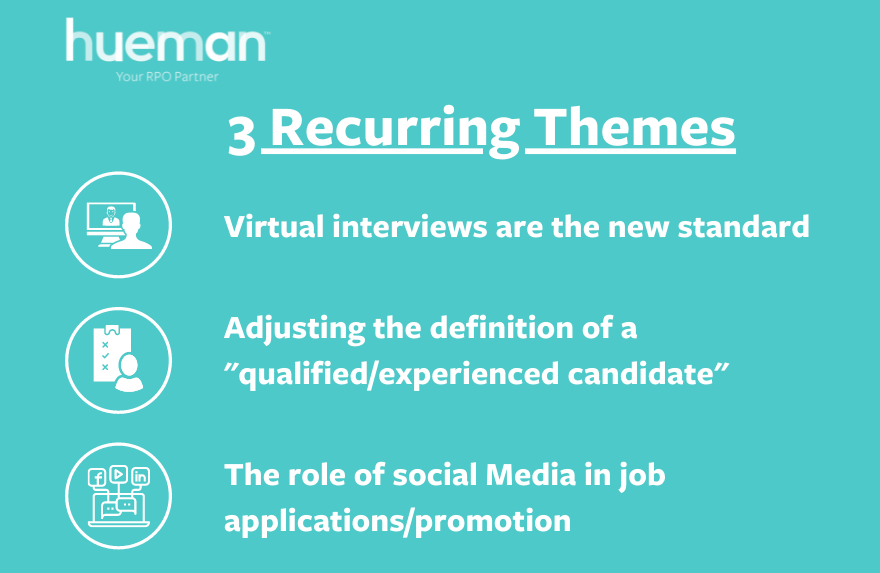
Across these conversations, three consistent themes emerged as defining changes in today’s recruitment landscape:
-
Virtual interviews are now the standard
-
The definition of a “qualified” or “experienced” candidate has evolved
-
Social media plays a critical role in job promotion and applications
These shifts continue to reshape how organizations attract, evaluate, and hire talent in a post-pandemic world.
Virtual Interviews Are Now the Standard
As companies transitioned to remote work over the past year, recruiters and hiring managers still faced pressure to fill critical roles. Video conferencing platforms like Zoom and Microsoft Teams quickly became the primary way to connect with candidates — and for many organizations, the new normal.
According to a Gartner poll, 86% of organizations adopted new virtual interviewing technology within two months of the pandemic’s onset. For recruiters, this shift came with an added challenge: helping hiring managers learn unfamiliar tools and adapt to conducting effective interviews in a virtual environment.
“Many hiring managers and recruiters weren’t using virtual interviews at all prior to the pandemic,” shared Hueman Recruitment Manager Brian Burdorf.
Fast forward a year, and even as more offices reopen, virtual interviews remain the preferred approach for many roles. Recruiters have replaced traditional screening phone calls with video interviews, and final interview stages often include a mix of in-person and virtual conversations. In some cases, virtual interviews are scheduled days before or after on-site visits, offering greater flexibility for everyone involved.
Overcoming resistance to virtual hiring
While adoption has increased, some hiring managers remain cautious about making hiring decisions based solely on virtual interviews.
Hueman Recruiter Julia Stevens shared that many of her hiring managers were initially hesitant to move away from in-person interviews. Helping them make the transition required patience, reassurance, and real-world proof.
“Once hiring managers saw how easy the process was — and experienced successful hires through virtual interviews — it quickly became their preferred method,” Stevens said.
To further support this shift, Stevens introduced Web Chat Wednesday, a virtual hiring fair that allows hiring managers to interview candidates online while still providing time to pre-screen resumes. As hiring managers gained confidence through repeated exposure to the format, virtual interviewing became more natural — and more effective.
Looking ahead
Virtual interviewing offers clear advantages: increased flexibility, reduced scheduling strain, and a safer experience for both candidates and hiring teams. Job seekers also recognize also recognize that organizations using virtual interviews are prioritizing safety and employee wellbeing.
Virtual interviews may be the future — but in-person interviews aren’t going away entirely.
Many recruiters will continue to rely on in-person interviews for roles that require hands-on experience or job shadowing. However, for many positions, virtual interviews will remain the first — and sometimes only — step in the hiring process.
Adjusting the Definition of A "Qualified/Experienced Candidate."
Recruiters are often tasked with filling hard-to-fill and high-volume roles — and doing so quickly. While more candidates are beginning to re-enter the job market as COVID-19 protocols ease, labor force participation remains at historically low levels.
“More candidates are beginning to job search as restrictions decrease and people feel more comfortable returning to work,” said Hueman Recruitment Manager John Morrison.
Despite this shift, the available talent pool remains constrained for a multitude of reasons. Some individuals feel more financially stable remaining on unemployment, others continue to have concerns about COVID-19 exposure, many still require at-home care support, and some are seeking employers that offer higher wages and more competitive incentives.
Navigating a tighter talent market
Economic uncertainty has made it increasingly difficult to attract candidates who meet traditional hiring expectations. Melissa Schoolcraft, a healthcare recruiter at Hueman, noted that roles such as nursing remain in extremely high demand.
“Recruiters will need to leverage a wider range of sourcing tactics to attract candidates,” Schoolcraft shared.
“Organizations may also need to reevaluate pay rates and incentives to remain competitive.”
Hueman RPO Manager Lisa Leifheit echoed this sentiment, particularly for organizations without a strong hiring infrastructure.
“Many companies may need to consider sign-on bonuses for roles that historically haven’t been difficult to fill,” Leifheit explained.
As organizations work to rebuild their workforce, compensation, incentives, and long-term retention strategies have become essential tools for success.
Redefining “qualified”
The fluctuating candidate pool has pushed recruiters and hiring managers to rethink what it truly means to be a “qualified” or “experienced” candidate. According to Morrison, motivation has become one of the most important indicators of long-term success.
“Understanding a candidate’s motivation is more critical now than ever,” Morrison said.
“Recruiters should ask why candidates are looking and remain open-minded when reviewing job history.”
Rebecca Lindgren, a Hueman team lead recruiter supporting a healthcare facility, emphasized the importance of adaptability — particularly in nursing roles.
“Sometimes bringing someone on with less experience and investing in training is the better option,” Lindgren shared.
“That approach can ultimately lead to stronger outcomes for both the employee and the department.”
Shifting priorities in hiring
While hiring managers may aim for the “perfect” candidate — one with ideal experience, years in a similar role, and a seamless cultural fit — that expectation isn’t always realistic in a rapidly changing talent market.
Instead of searching endlessly for the “perfect” candidate — one with ideal experience, years in a similar role, and an exact cultural match — hiring managers should reassess what truly defines success.
Rather than trying to check every box, including specific degrees or years of industry experience, organizations should look for candidates with:
-
Strong communication skills
-
Technological proficiency
-
A flexible, adaptable approach to work
-
A growth-oriented mindset
By redefining what qualifies as the ideal hire, recruiters and hiring managers can access a broader, more diverse candidate pool while still meeting business needs in a competitive and rapidly changing talent market.
The Role of Social Media in Job Applications/Promotion
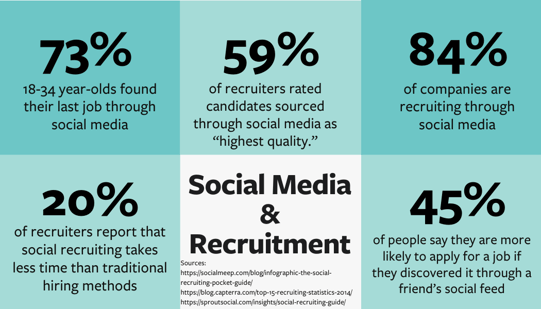
While social media has been around for years, its role in recruitment has expanded significantly in the wake of the COVID-19 pandemic. What was once a secondary channel has become a central tool for attracting candidates and promoting employer value propositions (EVPs).
“Social media was a tool we didn’t previously leverage the way we do now, and I think it will remain a constant,” shared Sarah Cantwell.
“This generation is dependent on marketing and social media channels, making them a key player in recruitment strategies and in promoting a company’s EVP.”
With a large percentage of Americans spending much of their time online and job seekers increasingly relying on mobile devices to search for opportunities, social platforms offer unmatched visibility for employers.
Many recruiters and recruitment managers agree that social media has become one of the most effective tools for quickly spreading awareness about job openings. Whether promoting open roles or advertising virtual hiring fairs, social media has evolved into a primary search engine for candidates.
Hueman Recruiter Julia Stevens noted an increase in nurses actively searching for opportunities on social platforms, leading organizations to compete more aggressively to promote their jobs and brand presence online.
Choosing the right platform
Different platforms serve different recruiting needs:
-
Instagram and Facebook are effective for showcasing company culture and hourly or frontline roles
-
LinkedIn works well for salaried positions and highlighting benefits or leadership content
-
Craigslist, as noted by John Morrison, has proven effective for warehousing and delivery roles
This platform diversity allows recruiters to meet candidates where they already are — rather than expecting them to come to traditional job boards alone.
Balancing the benefits and challenges
Social media is a powerful tool for promoting job openings and strengthening an organization’s EVP. It enables direct communication with candidates, expands reach, and supports employer branding. However, it also introduces new challenges.
“Social media is a great tool, but it often gives candidates access to superficial data around salaries and benefits,” said Andrew Foran, Hueman RPO Partnership Manager.
“That information isn’t always accurate, but it can influence negotiation expectations.”
Candidates may rely on one-off salary data or anecdotal information found online, which can complicate compensation discussions and create misalignment early in the hiring process.
To mitigate these risks, organizations must actively monitor and manage their presence on platforms like Glassdoor and Indeed. Ensuring that accurate information is shared — and addressing reviews or comments proactively — is essential to protecting employer reputation and maintaining transparency during negotiations.
Strengthening communication and collaboration
Despite the challenges, social and digital tools have also strengthened internal communication among recruiting teams.
“One of my biggest successes this past year has been the relationships built with managers and leaders across the organizations I support,” shared Sarah Cantwell.
Brian Burdorf echoed that sentiment, noting how virtual collaboration brought teams closer together.
“Once we moved fully remote, our team leaned heavily on instant messaging,” Burdorf said.
“Our team chat became a space to share ideas, candidates, updates — and even jokes. It’s kept us connected and engaged and will continue to be a key part of how we communicate moving forward.”
Looking ahead
Social media has proven it is here to stay as a critical recruitment tool. As the talent market continues to evolve, recruiters and hiring managers must remain focused on best practices, emerging trends, and thoughtful platform use to effectively promote their organizations, strengthen employer branding, and compete for top talent.
While the past year challenged recruiting teams in unprecedented ways, it also accelerated innovation and collaboration across hiring functions. Moving forward, talent acquisition leaders must remain agile and attentive to ongoing market shifts — leveraging tools that facilitate communication, increase visibility, and support meaningful candidate engagement throughout the hiring process.
For insights on building a world-class recruitment program, download our latest eBook.