

How to Build a Clinical Recruiting Pipeline That Actually Fills Vacancies
Picture the moment: a critical care unit with three open RN roles, one of them 47 days old. The hiring manager has escalated twice. A traveler contract that was supposed to end this month is being renewed for the third time. The job board is live. The sourcing has started. And the timeline to fill is, optimistically, another six weeks.
Most TA leaders and CNOs know that this moment is a failure of infrastructure. The req opened and the search started simultaneously, which means every search starts from zero. That is what reactive hiring looks like structurally. Unfortunately, that is the model most health systems are still operating.
A clinical recruiting pipeline is a different thing entirely. It exists before the vacancy opens, which means when the req drops, there are warm candidates already in relationship, not cold applications waiting to be generated. A pipeline can be built. This article covers exactly how.
The Reactive Cycle: Why Your Team Is Working Hard, and the Vacancies Stay Open
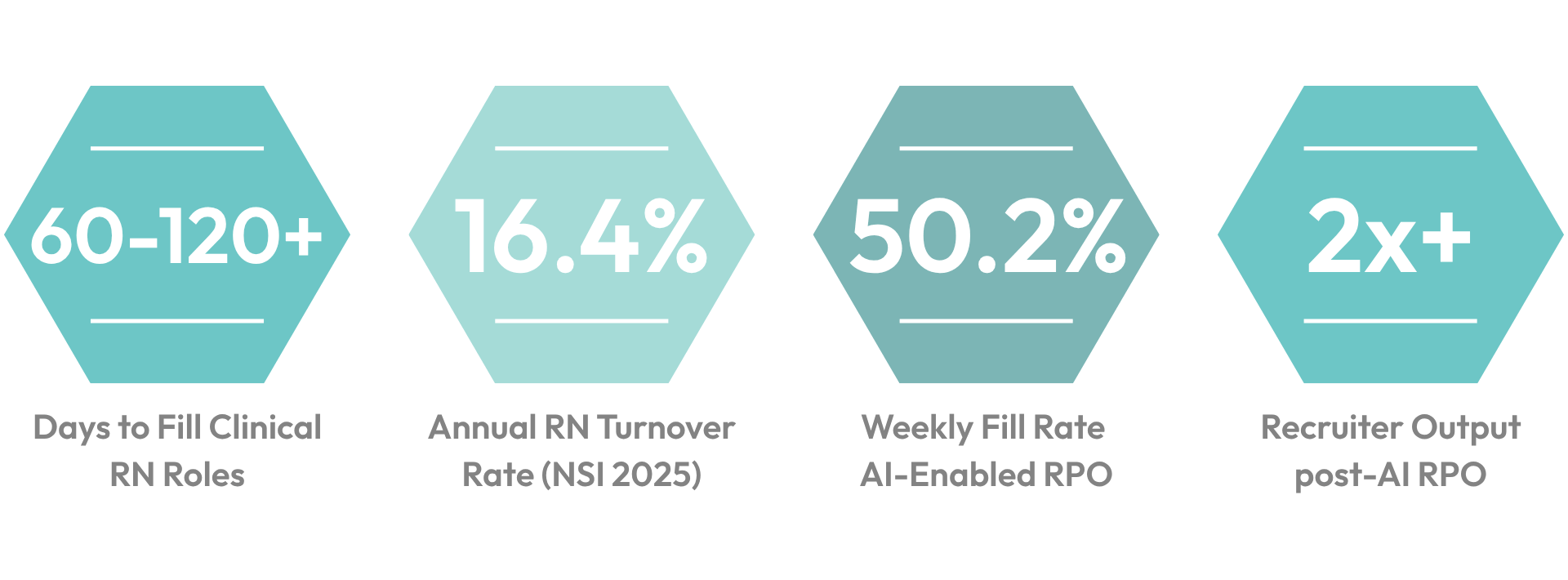
The reactive model is a response system: a vacancy opens, the job board goes live, sourcing begins, 60 to 120 days pass, a traveler fills the gap, the contract renews, and the cycle repeats. The 2025 NSI National Health Care Retention & RN Staffing Report confirms average RN turnover of 16.4% in 2024, with step-down, emergency services, and behavioral health significantly higher. Experienced RNs take an average of 83 days to recruit, with hard-to-fill specialties stretching well beyond 120 days. That turnover rate means the vacancy queue is structural, not situational.
The comparison below shows how the reactive model differs from a proactive pipeline across the dimensions that matter most to TA leaders and CNOs. One framing note before the table: the reactive column reflects the current state in most health systems. 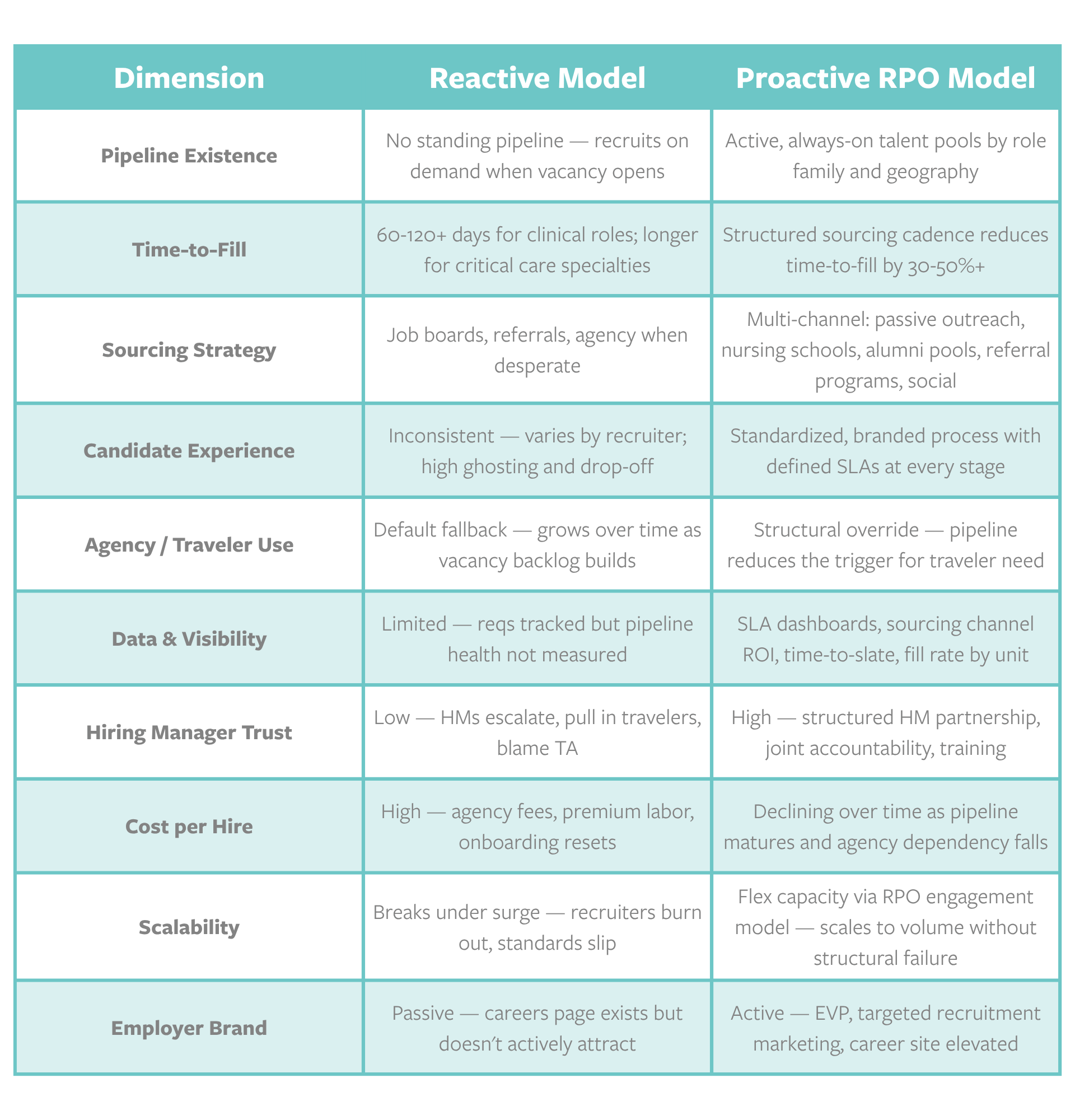
Sources: NSI 2025 National Health Care Retention & RN Staffing Report | Becker’s Hospital Review, 2025 | Hueman Healthcare RPO analysis.
What a Clinical Pipeline Actually Is (And Why a List of Past Applicants Is Not One)
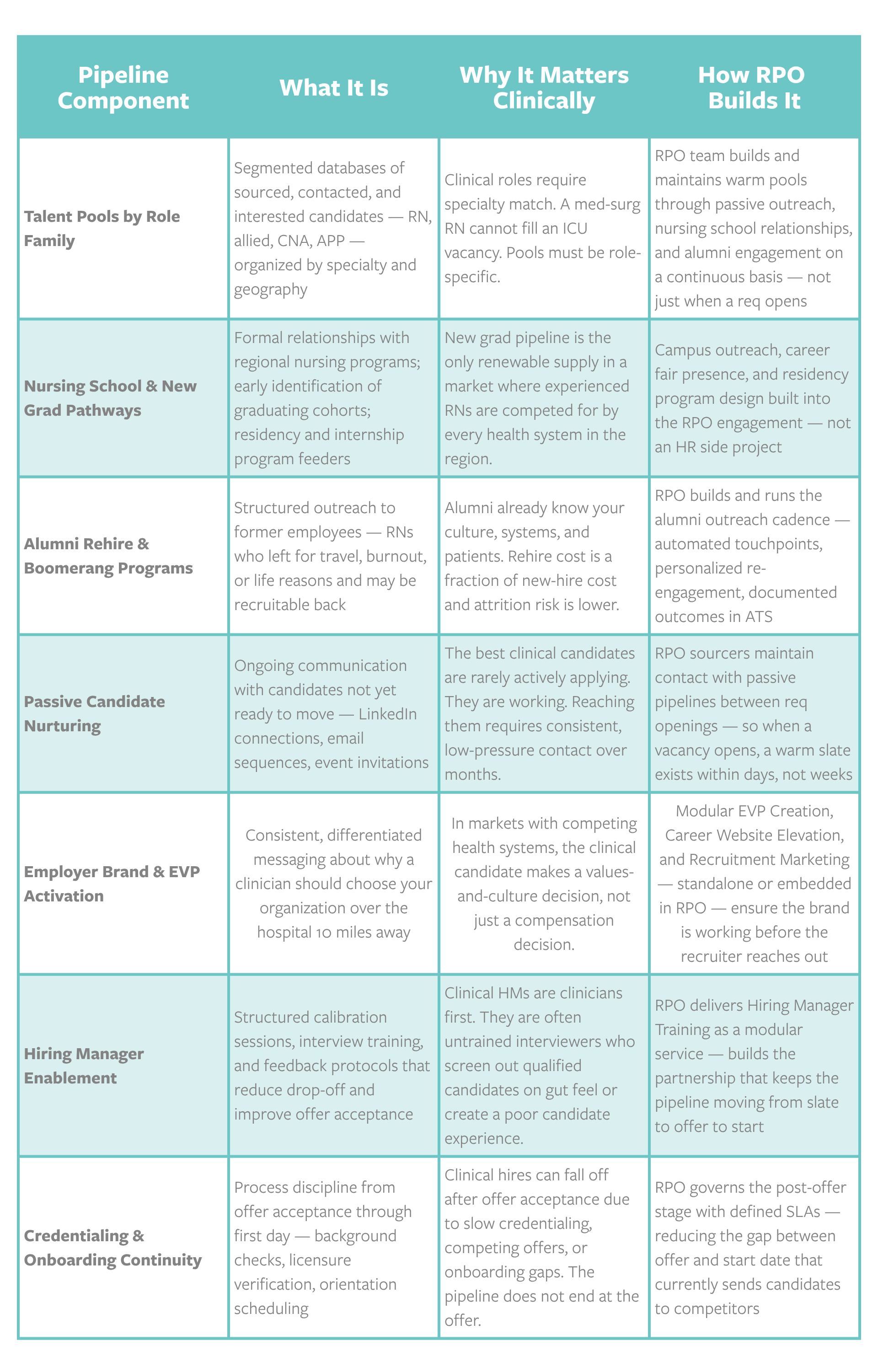
Most TA functions have ATS records. Very few have an actual pipeline. The distinction is important: a pipeline isn't a list of people who applied six months ago and have moved on to other roles. Instead, it's an active, ongoing system of relationships with candidates who may not be ready to make a move now but will be in the future, and who are already familiar with your organization when that time comes.
A proactive clinical pipeline has seven components. Most reactive TA functions have none of them fully built. Here is what each one is and what it takes to activate it:
Sources: NSI 2025 RN Staffing Report | AACN Nursing Faculty Shortage Fact Sheet | AHA 2026 Healthcare Workforce Scan | Hueman RPO clinical recruiting experience.
Six Steps to Build a Clinical Recruiting Pipeline From Where You Are Now
The framework below is designed for TA leaders and CNOs who are building the case internally or evaluating whether to do so with a partner. Each step is one action, not a program launch.
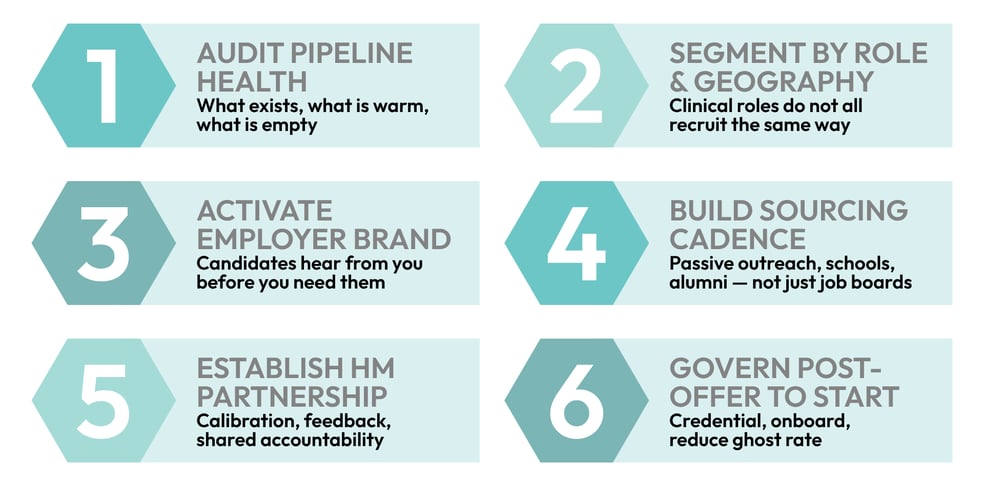
Step 1: Audit pipeline health. Pull ATS data on active candidate counts by role family and identify which requisitions have zero warm pipeline. Most TA leaders cannot answer the question, “How many warm RN candidates do we have for the ICU right now?” The honest answer is usually zero to a handful. The audit makes that visible and gives you a baseline to build from.
Step 2: Segment by role family and geography. The sourcing strategy for a med-surg RN in a mid-size metro is completely different from an ICU travel nurse conversion in a rural safety-net hospital. Job boards alone do not answer the latter. Segmentation means building separate pipelines for distinct talent markets, not a single ATS with everyone lumped together.
Step 3: Activate employer brand in target markets. Your EVP is a pipeline tool, not a marketing exercise. If clinical candidates have never heard of your organization before you have an open req, every search starts from zero. Targeted recruitment marketing, a strong careers site, and a differentiated EVP mean candidates already have a relationship with your brand before a recruiter reaches out.
Step 4: Build a sourcing cadence. Sourcing cadence means scheduled, recurring outreach regardless of open reqs: nursing school relationship management, LinkedIn passive outreach to clinical professionals, alumni touchpoints, and referral program maintenance on a weekly or monthly schedule. The goal is a warm network before you need it, not a burst of activity when the req drops.
Step 5: Establish a partnership with the hiring manager. In clinical settings, the HM is a charge nurse, a unit director, or a department head managing patient care simultaneously. Interview training, calibration sessions, and defined feedback SLAs are pipeline protection. A HM who ghosts a debrief or screens out qualified candidates on gut feel is destroying pipeline velocity. The traveler contract that follows is directly traceable to that gap.
Step 6: Govern post-offer to start date. The pipeline does not end at the offer. In clinical hiring, the credentialing, licensure verification, and orientation scheduling window is where candidates are most vulnerable to competing offers. Define the timeline from offer to start. Assign ownership of each step. Create proactive communication touchpoints during the credentialing window. Every day of silence is a retention risk.
Why RPO Is the Engine That Makes This Work at Scale
The six steps above describe what needs to happen. Most health systems cannot build a proactive pipeline while simultaneously managing a backlog of open reqs with an overworked team. The capacity is not there. The recruiting infrastructure does not exist. Adding permanent TA headcount to solve it costs more than the problem, without the sourcing depth, clinical market knowledge, or technology infrastructure that a purpose-built clinical recruiting function brings.
Healthcare RPO is how under-resourced health systems or those lacking TA infrastructure actually execute this framework. The RPO model provides dedicated capacity, recruiting leadership, sourcing infrastructure, and a governance model to build the pipeline and fill the backlog simultaneously. The engagement model meets organizations where they are: full-lifecycle outsourcing for systems seeking a complete TA transformation, hybrid RPO for clinical pods embedded alongside an existing team, and project RPO for new facility openings or seasonal surge ramps with defined timelines.
For organizations managing chronic physician or APP vacancies that strain clinical operations, Hueman’s APP and Physician Recruitment solution operates with the structure and accountability of an RPO partnership, built specifically for hard-to-fill clinical leadership roles.
The proof that it works under pressure: one major regional health system implementing AI-enabled RPO saw recruiters go from 209 to 488 hires per recruiter, and the weekly fill rate climbed from 10.8% to 50.2%. That is what building the pipeline and filling the backlog looks like simultaneously. The open requisition count per recruiter dropped from 54 to 27 in the same period. Fewer open reqs means fewer traveler-backfill trigger events. That is the compounding benefit a pipeline delivers.
For a complete look at how health systems are building resilient recruiting infrastructure under Medicaid pressure, read the full strategy guide:

Where Is Your Pipeline Weakest Right Now?
The first step does not have to be a full transformation. For most health systems, the right entry point is where the vacancy rate is highest, and the pipeline is emptiest. The three most common starting points are:
-
A specific unit or role family where the vacancy rate is highest, and the traveler dependency is most visible.
-
A new facility or expansion requiring a pipeline build from scratch, with a defined go-live date that cannot be moved.
-
A seasonal hiring ramp is 90 days away, with no warm pipeline in place, and the alternative is to activate traveler contracts again.
Any of those is a starting point. None of them requires building the entire framework at once. What they all require is to stop the reactive cycle at one clear point and build something different in its place.