

Manufacturing Market Report
Growth Is Returning, Is Your Workforce Ready?
After years of supply chain disruption and economic volatility, signs point to renewed strength in manufacturing. Production is trending upward. Domestic investment continues. Automation is rapidly evolving on factory floors.
But one constraint hasn’t budged: skilled labor.
Despite overall employment being steadier, critical technical and frontline roles remain tough to fill. According to the U.S. Bureau of Labor Statistics, job openings in manufacturing remain high, outpacing available talent. For plant leaders and HR executives, the urgent question is no longer whether demand will return, but whether their workforce will be ready when it does.
Building Capability, Not Just Capacity
Beyond the Shortage: Why the Skills Gap Is Here to Stay
The Institute for Supply Management (ISM) Manufacturing Report on Business® recently reported a return to expansion following an extended period of contraction, signaling an improvement in production activity. Additionally, the Federal Reserve Industrial Production and Capacity Utilization Report shows selective gains across advanced manufacturing segments, including electrical equipment, transportation equipment, and high-tech production.
Capacity is expanding, but workforce pipelines have not kept pace.
Even during periods of moderated production, manufacturers report difficulty hiring for highly technical roles. The National Association of Manufacturers (NAM) Workforce Policy Resources consistently rank workforce issues among manufacturers’ top concerns, particularly in skilled trades such as CNC machinists, maintenance technicians, welders, and automation specialists.
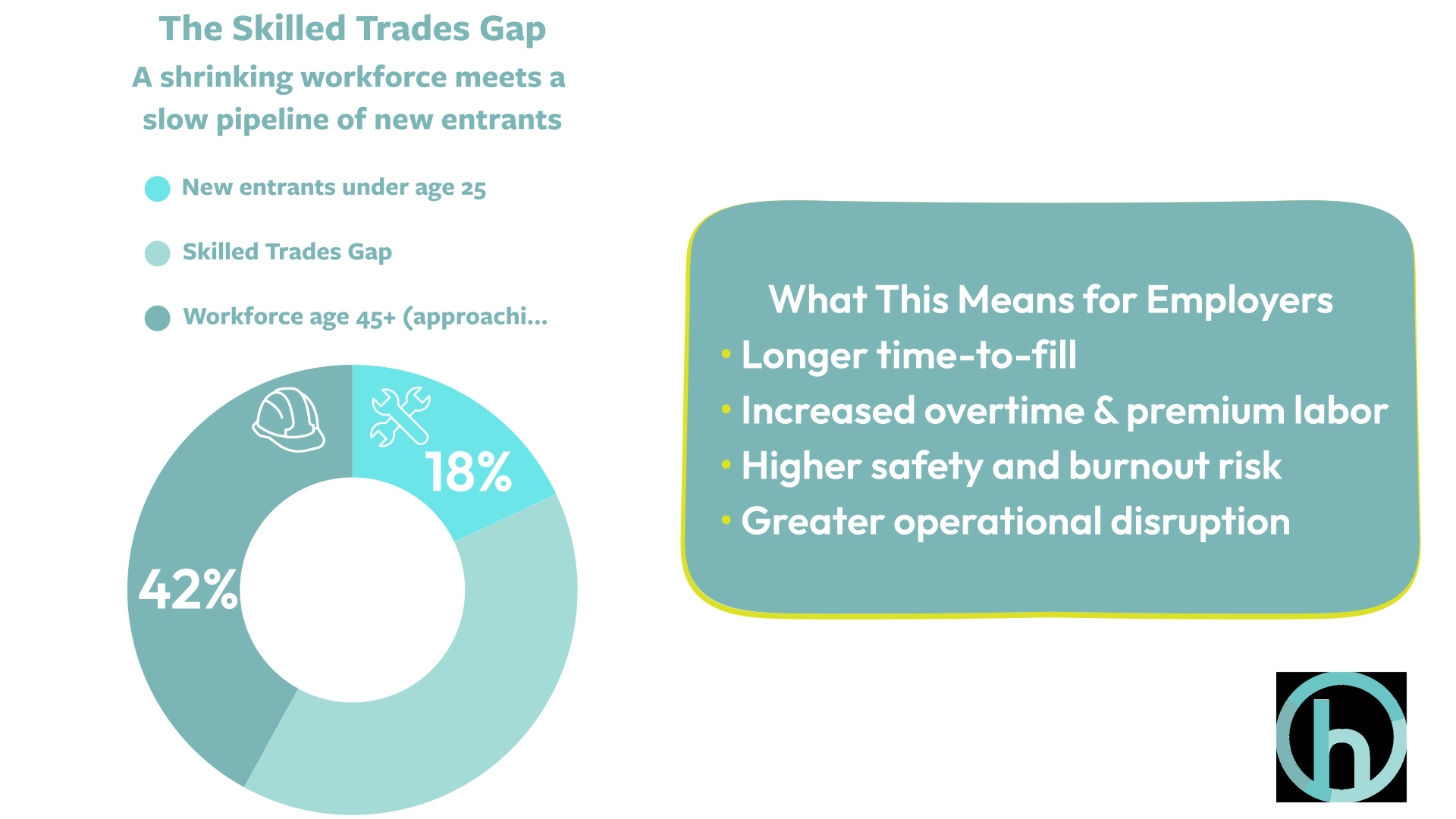
The Manufacturing Institute Workforce Research projects that millions of manufacturing jobs could remain unfilled over the coming decade due to retirements and skill shortages. Many skilled trades professionals are nearing retirement, while apprenticeship and technical training programs haven’t scaled quickly enough to meet industry needs.
This isn’t just a temporary gap; it’s a demographic and structural challenge.
Automation Is Raising the Skill Bar
Automation continues to transform production environments. Industry research from McKinsey & Company, Manufacturing & Supply Chain Insights, and the Deloitte 2026 Manufacturing Industry Outlook highlights that robotics, AI-enabled quality systems, and predictive maintenance technologies are accelerating use across U.S. plants. But automation does not eliminate labor demand; it shifts it.

Turnover and Labor Instability Affect Throughput
While overall labor turnover has moderated since pandemic peaks, manufacturing continues to see constant job openings. According to the BLS Job Openings and Labor Turnover Survey (JOLTS), manufacturing openings remain elevated across multiple subsectors.
.svg)
Labor instability is no longer an HR issue alone. It is a financial and operational risk.
Building Workforce Infrastructure, Not Just Filling Roles
Manufacturing hiring requires more than reactive requisition management. The most resilient organizations are building structured workforce planning, retention-focused recruiting, and scalable talent infrastructure aligned to production demand. At Hueman, we help manufacturers move beyond short-term staffing relief toward sustainable employee stability.
Strategic Workforce Planning Aligned to Production
We partner with manufacturing leaders to align hiring forecasts with:
- Production schedules
- Facility expansions
- Equipment installations
- Retirement projections
- Regional labor availability
Rather than reacting to shortages, we help build proactive pipelines, especially for high-skill technical roles.
Flexible, Modular RPO for Manufacturing Cycles
Manufacturing demand fluctuates with seasonality, supply chain shifts, capital projects, and broader economic cycles. Modern RPO enables manufacturers to scale recruiting capacity up or down without permanently expanding internal headcount. As highlighted in Hueman’s RPO Transition Guide, flexibility and workforce analytics are key differentiators when evaluating talent acquisition models.
We provide:
- Enterprise RPO (Fully Outsourced)
- Role-based (Partially Outsourced)
- Project RPO for seasonal or surge needs
Looking Ahead
The next phase of manufacturing growth will not be determined solely by capital investment or automation. It will be defined by talent readiness. Plants that can reliably staff advanced equipment, retain technical expertise, and anticipate demographic shifts will protect margins and strengthen competitive position.
At Hueman, we believe people are the foundation of every production line. When the right people are in the right roles at the right time, operational performance follows.
Connect with our team today to start building a more resilient manufacturing workforce.