

Here Is What TA Leaders Need to know.
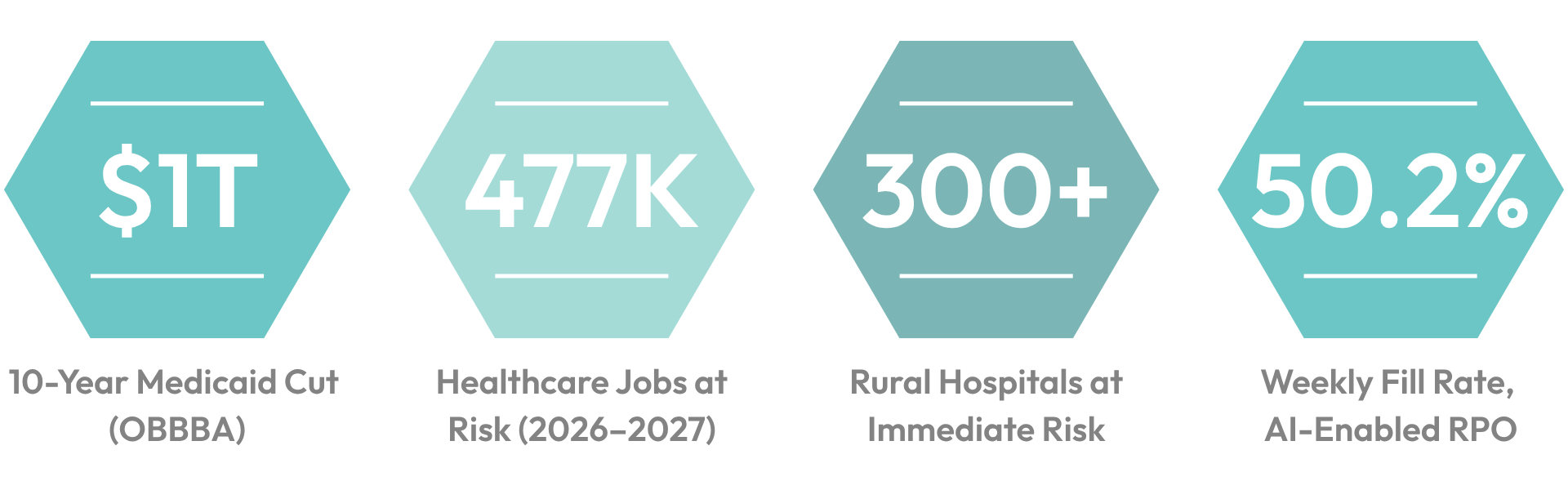
The One Big Beautiful Bill Act, signed into law on July 4, 2025, cuts nearly $1 trillion in federal Medicaid funding over ten years. Work requirements for expansion enrollees take effect in January 2027. Eligibility redeterminations begin in 2026. States lose key provider tax authority that funded their share of Medicaid costs.
For HR and talent acquisition leaders at health systems, this is a problem that is already changing what your organization can afford to spend on recruiting, how long roles are sitting open, and what your premium labor line looks like at the end of each quarter.
The decisions being made right now will determine which health systems absorb this pressure and which scramble to cope with it.
What the Bill Actually Does, Through a Talent Acquisition Lens
The financial mechanics matter, but only as they land on your TA function. Here is the chain: Medicaid represents roughly 20% of hospital revenue on average, and for rural and safety-net hospitals, that figure runs closer to 40%-50%. When reimbursements decline, operating margins compress. When margins compress, budget reviews follow. Recruiting headcount, technology, and agency spend are typically among the first line items examined.
The Congressional Budget Office projects the cuts will put approximately 477,000 healthcare jobs at risk nationally between 2026 and 2027. Over 300 rural hospitals have already closed since 2010, and more are now at immediate risk. Those closures consolidate demand for clinical talent into fewer systems, intensifying competition in already-thin hiring markets.
The work requirements and eligibility redeterminations arriving this year add administrative complexity for health systems already operating with lean staffing ratios. The policy creates uncertainty in patient volume projections, which in turn makes workforce planning harder to anchor.
The Workforce Domino Effect: From Budget Cuts to Vacancy Spikes
The financial pressure is real, but it lands on a system that was already structurally strained before the bill passed. Understanding that sequence matters for how TA leaders frame the problem internally.
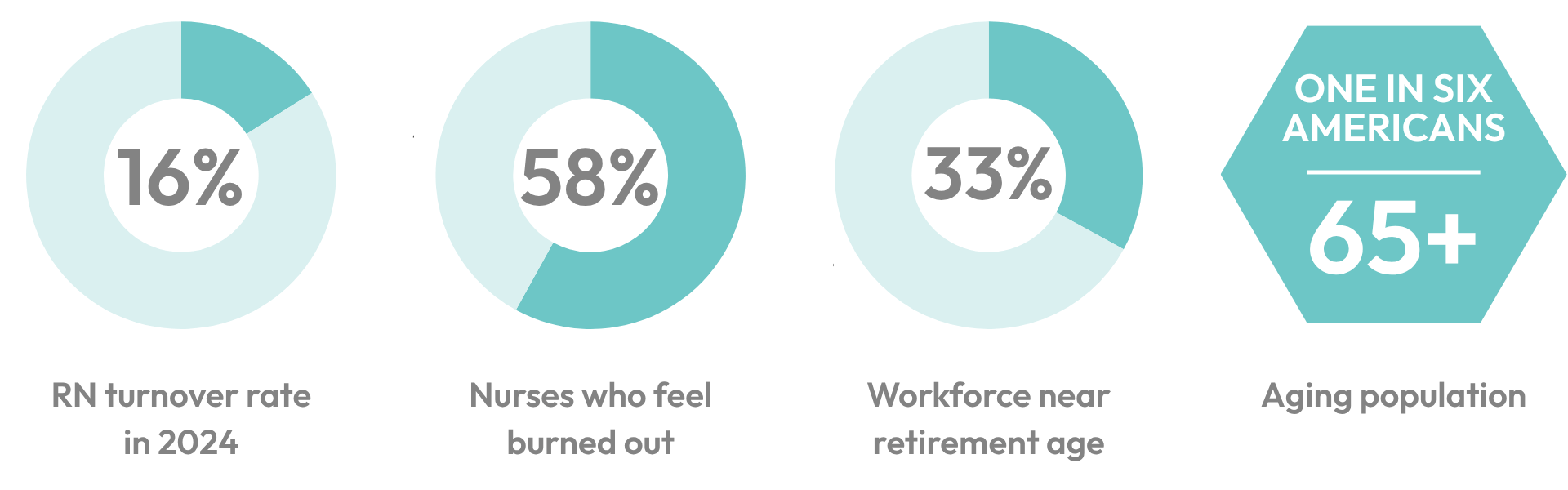
The U.S. will have approximately 197,200 registered nurse job openings per year through 2033, while only an estimated 177,400 new nurses will enter the workforce annually. National RN turnover sat at approximately 16% in 2024. Clinical burnout is accelerating exits: nearly 58% of nurses report feeling burned out on most days, and approximately 33% of the nursing workforce is approaching retirement age. An aging population, with one in six Americans now 65 or older, is driving up demand for care at precisely the moment the clinical supply chain is thinning.
Health systems were operating near the edge before the cuts arrived. What the bill does is compress the timeline and reduce the margin for error. Budget pressure flows to hiring freezes, which flow to open req accumulation, which flow to agency and traveler dependence, which flow to higher premium labor spend, which flow back to further budget pressure. Hueman’s Healthcare Job Market Report tracks these workforce dynamics in real time, helping clinical and TA leaders navigate planning decisions under such pressure.
This brings us to a critical focus
When vacancy rates climb and internal teams are stretched, most organizations reach for what is familiar: travel nurses, per-diem contracts, and agency relationships. It fills the shift. It keeps the unit staffed through the weekend. And it is the most expensive possible response to a problem that compounds over time.
Travel nurse rates have declined from their pandemic peak, with SIA projecting total travel nurse revenue at approximately $14.3 billion in 2026, down from $44.6 billion in 2022. Lower than peak is not affordable when reimbursements are simultaneously contracting. Travel nurses still earn roughly 27% more than permanent staff on a per-hour basis, and agency markup compounds on top. During surge periods, bill rates move with demand. Premium labor is variable and unpredictable by design. That cost structure is the wrong foundation for a margin-constrained operating environment.
Beyond the financial cost, traveler dependency creates operational drag. Permanent staff carry a greater continuity burden. Onboarding repetition slows unit cohesion. And the time TA teams spend managing contract logistics is time not spent building the pipelines that would reduce the need for contracts in the first place. Read more on why travel nursing has become a costly dependency for health systems and what the alternative looks like in practice.
What Sustainable Healthcare Staffing Actually Looks Like Right Now
The health systems absorbing this pressure built recruiting infrastructure before the crisis required it. Healthcare RPO is the mechanism for that shift. An embedded recruiting partnership, whether full lifecycle, hybrid, or project-scoped, brings dedicated clinical recruiting pods, defined SLA accountability, governance visibility, and continuous pipeline activity. The talent pool is being built between surges, not assembled during them.
The results from one major regional health system following the implementation of AI-enabled RPO are instructive. Recruiters went from 209 hires per recruiter to 488. Weekly fill rate rose from 10.8% to 50.2%. Average open requisitions per recruiter dropped from 54 to 27. Across a team of four recruiters, the partnership produced more than 1,100 additional hires over a comparable period. These are not projections. This is already happening in health systems operating under exactly the kind of margin pressure the bill is accelerating.
For health systems actively managing premium labor spend, Hueman’s Travel Nurse Reduction Program provides a structured path to replace contract labor with permanent staff as traveler agreements end, resulting in average annual savings of $3M or more. One partner achieved a 61% reduction in travel nurse utilization and $48M in annual labor savings.
The organizations absorbing this shock built their pipelines before it hit.
For a deeper look at how health systems are building resilient recruiting under these conditions, read the full guide.

As we look to the future, it’s clear the window for action is open, but it won’t stay that way.
Travel nurse rates are normalized, making the cost comparison between permanent hiring and contract labor the most favorable it has ever been. That window will close when the next surge cycle drives bill rates back up. Medicaid work requirements take full effect in January 2027, adding an administrative burden and unpredictable patient volume at exactly the wrong moment for systems that have not yet stabilized their TA infrastructure. Seasonal demand cycles are not going away.
The organizations that begin building permanent pipelines now will have candidates in the queue when the next surge hits. They will have SLA visibility to show their CFO a predictable cost model rather than an agency spend line that moves with market conditions. They will have the 90-day retention data to demonstrate that their hiring investment is holding.
The ones that wait will be competing for travelers again at peak pricing, while simultaneously managing the fallout of Medicaid-driven budget pressure.
If you are building your TA strategy for the next 12 months, start here.
The CFO-facing one-pager on RPO economics in a margin-pressure environment.